Many families struggle with SAT preparation in 2026, even when their children perform well in school. Parents often assume strong grades mean SAT readiness. However, that is not always true. The SATs test how students think, read, and solve problems under pressure. Consequently, many students struggle with the SAT despite years of classroom learning.
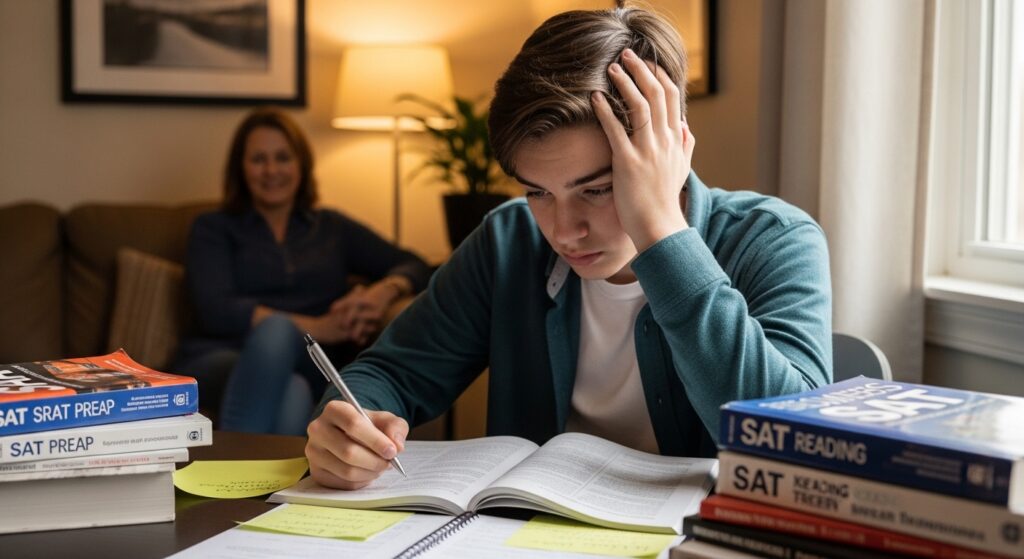
On a calm Wednesday evening in Palo Alto, fourteen-year-old Zayden sat with an SAT practice booklet open on the table. His grades were strong. Teachers praised his effort. Yet, the questions felt confusing. He read the passage twice. Still, the answers did not feel clear.
Why Strong Students Still Struggle With the SAT
Many parents view the SAT as just another school test. However, the SAT works differently. It rewards reasoning, speed, and decision-making. Memorisation alone is not enough. Because of this, even high-achieving students struggle with SAT questions.
Research from the College Board shows that students with structured preparation often score far higher than those without it. Therefore, students are not failing; they are unprepared for the test’s format and pressure.
Hidden Reading Challenges That Affect SAT Scores

Reading plays a major role in why students struggle with the SAT. Passages are long. Questions are subtle. Many students can read, yet they struggle to understand meaning under time pressure.
For example, Nael, a student from Ann Arbour, loved science. He solved complex problems with ease. Yet SAT reading passages slowed him down. A reading comprehension tutor later identified gaps in inference and pacing. With focused reading tutoring, his accuracy improved quickly.
Some students benefit from a reading tutor or a reading and writing tutor. Others need a comprehension tutor who teaches structure and context. Additionally, tutoring for dyslexia can help when processing speed affects confidence.
Why SAT Math Feels Different From School Maths

SAT maths is not about repeating formulas. It focuses on logic and application. Questions often change format. As a result, many students feel frustrated.
Math tutoring that teaches flexible thinking helps students adapt. Many families see progress with tutoring in mathematics that focuses on problem-solving. Furthermore, an online math tutor can help students practise efficiently and stay consistent.
How Science Skills Influence SAT Performance
Although the SAT does not test science directly, scientific thinking still matters. Students must read charts, analyse data, and draw conclusions.
Students working with a physics tutor or tutoring in chemistry often improve their reasoning skills. Consequently, these skills transfer across all SAT sections, especially maths and reading.
When Parents Should Seek Extra Support
Parents often wait too long before getting help. Early support reduces stress and builds confidence. Short, focused sessions work better than long study hours.
STEM Prep Tutoring offers personalised one-on-one support designed around how students learn best. Therefore, families exploring SAT help can learn more at https://stempreptutoring.com
Practical Steps to Reduce the Struggle With the SAT
Start by observing how a student studies. Notice where frustration appears. Some struggle with timing. Others struggle with comprehension.
Next, choose targeted tutoring. Reading tutoring that focuses on clarity and pacing improves accuracy. Additionally, working with experienced reading tutors helps students stay calm under pressure.
For maths, focus on reasoning rather than repetition. Math tutoring that adapts to a student’s pace builds confidence. Students working with an online math tutor often progress faster.
Create a simple routine. Education researchers recommend daily practice sessions of 30 to 45 minutes. Consistency matters more than volume.
Emotional readiness also matters. Test anxiety contributes significantly to why students struggle with SAT. Research from the American Psychological Association shows that reducing anxiety can improve performance by up to 20%.
Trusted Research and Learning Resources
Parents can explore national testing trends at https://nces.ed.gov. Broader insights into education and assessment are available at https://www.brookings.edu. Ongoing education research can be found at https://www.rand.org.
For continued guidance, families can explore practical articles on academic success at the STEM Prep Tutoring Blog Page. These resources help parents stay informed without feeling overwhelmed.

Helping Students Move Forward With Confidence
Struggling with the SAT in 2026 does not define a student’s future. With the right guidance, progress is possible. Parents who want personalised support or have questions can reach out via our contact page
. Early action often makes the biggest difference.