The Silent Barrier to SAT Success
Every year, families invest in SAT Prep courses, practice books, and online modules. Yet when results arrive, many students’ SAT Scores fall short of expectations. The surprising culprit is weak reading skills.

The SAT does not simply test maths or grammar. Instead, it measures comprehension. Because every section begins with words, students who cannot decode those words quickly and accurately see their SAT Scores decline — even in maths and science.
A Story That Feels Familiar
Consider Amelia, a student who excelled in physics. Equations thrilled her, experiments made sense, and she explained concepts with ease. However, when she sat for the SAT, she stumbled. Wordy maths problems confused her, reading passages drained her energy, and she misinterpreted questions.

Her parents enrolled her in group prep classes, hoping repetition would help. Unfortunately, it didn’t. What Amelia needed was not more practice tests but a reading comprehension tutor who could slow down, teach annotation strategies, and rebuild her confidence. Once she worked with a one‑on‑one reading tutor, her SAT Scores began to climb.
Stories like Amelia’s occur frequently. In fact, students who need a comprehension tutor, a reading and writing tutor, or even tutoring for dyslexia often find themselves overlooked in large classes.
Why Reading Skills Matter Everywhere
Weak reading skills ripple across the entire exam. For example:
- Maths word problems: Students misinterpret what the question demands.
- Science passages: Dense texts overwhelm learners without decoding strategies.
- Writing and language: Grammar questions hinge on understanding context.
Therefore, tutoring in mathematics, physics, or chemistry cannot reach its full potential if students fail to understand the questions. Reading tutoring becomes the foundation of SAT success.
The Emotional Toll on Families
Parents often feel helpless, watching their child’s SAT Scores stagnate despite effort. Consequently, frustration builds, confidence erodes, and motivation fades. The emotional impact is real: students begin to doubt their intelligence, while parents worry they have failed to support them.
One‑on‑one tutoring changes that narrative. A reading tutor or online maths tutor adapts lessons to each child’s pace, celebrates small wins, and rebuilds confidence step by step. As a result, families regain hope and students rediscover motivation.
What Families Gain from Personalised Tutoring
By strengthening reading skills through one‑on‑one tutoring, families gain:
- Improved comprehension: Students learn to decode complex passages.
- Better test performance: Reading skills boost SAT Scores across all sections.
- Confidence: Learners approach exams with clarity and calm.
- Tailored support: Whether it’s a reading comprehension tutor or maths tutor, lessons adapt to individual needs.
- Lifelong literacy: Skills extend beyond exams into academic and professional success.
Moreover, these benefits extend well beyond test day, shaping how students learn and grow in every subject.
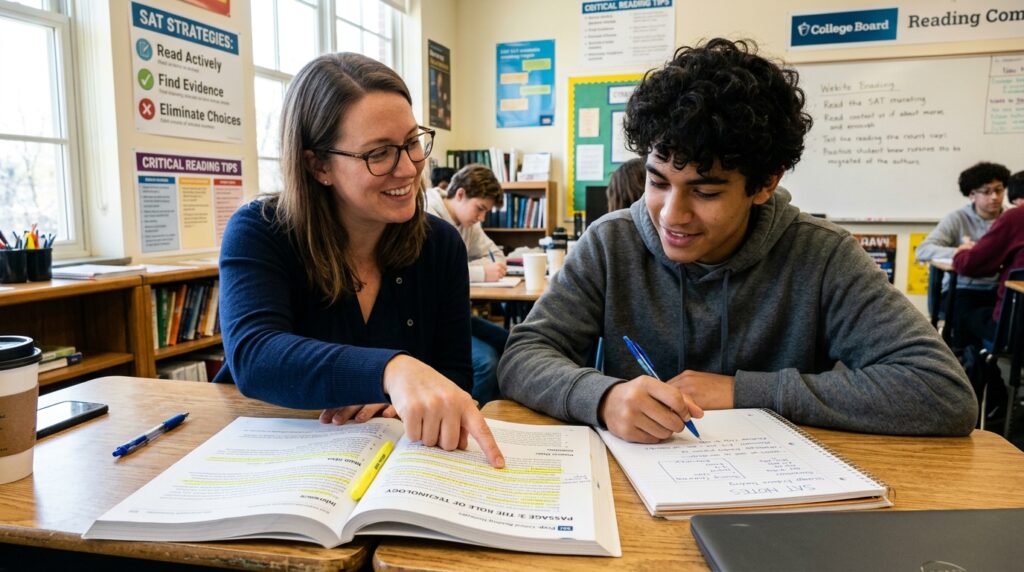
How One‑on‑One Tutoring Builds Reading Strength
Parents often ask how tutoring improves SAT Scores. The process works step by step:
- Diagnostic assessment: Tutors identify specific reading weaknesses.
- Targeted strategies: A reading tutor teaches annotation, summarisation, or inference skills.
- Active practice: Students engage with SAT‑style passages under guidance.
- Feedback loops: Tutors refine approaches based on progress.
- Confidence coaching: Learners develop resilience and test‑taking stamina.
For students with dyslexia, tutoring for dyslexia involves multisensory methods. A comprehension tutor addresses challenges with empathy and expertise.
Meanwhile, parents can reinforce progress at home by encouraging daily reading, discussing articles, and modelling curiosity. As a result, these habits, combined with expert tutoring, elevate SAT Scores.
Research That Speaks Volumes

Studies show that reading ability is the strongest predictor of SAT Scores. Insights from the National Literacy Trust reveal that strong reading comprehension directly links to academic achievement, making it a critical skill for exam success.
Moreover, reporting by The Hechinger Report highlights how students with tailored reading strategies consistently outperform peers in standardised assessments.
In addition, Education Week demonstrates that targeted reading tutoring improves outcomes across subjects, proving that weak reading skills can undermine SAT Scores even in maths and science.
Beyond the Numbers: Building Resilient Learners
SAT Scores matter, but the benefits of strong reading skills extend far beyond test day. Students who master comprehension become better learners in every subject. They approach challenges with curiosity, communicate ideas clearly, and develop resilience that lasts into adulthood.
Ultimately, tutoring is not just about raising SAT Scores; it unleashes potential. A reading tutor or maths tutor becomes more than an instructor — they act as a mentor who helps students believe in themselves.
Parents deserve peace of mind knowing their child’s SAT Scores reflect their true potential. Explore more insights on our blog or connect directly through our contact page to discover how one‑on‑one tutoring transforms results.