If you’ve ever wondered how the Digital SAT is scored, you’re not alone. One of the biggest misconceptions among students and parents is that every question carries the same weight or that your score is simply the percentage of questions you answered correctly.
The reality is more nuanced.
The Digital SAT uses a scoring process designed to measure a student’s readiness for college while ensuring fairness across different versions of the exam. Understanding how the test is scored can help you study more strategically, interpret your practice test results accurately, and set realistic score goals.
In this guide, we’ll explain:
- How the Digital SAT scoring system works
- What adaptive testing means
- How section scores are calculated
- Whether harder questions are worth more points
- What a “good” SAT score looks like
- Tips to improve your score faster
Whether you’re taking your first SAT or trying to improve your score for college admissions, this guide will help you understand exactly what your score means.

What Is the Digital SAT?
The Digital SAT is the computer-based version of the SAT administered by the College Board. It measures the knowledge and skills students need for college and consists of two major sections:
- Reading and Writing
- Math
Each section is divided into two modules, making a total of four modules.
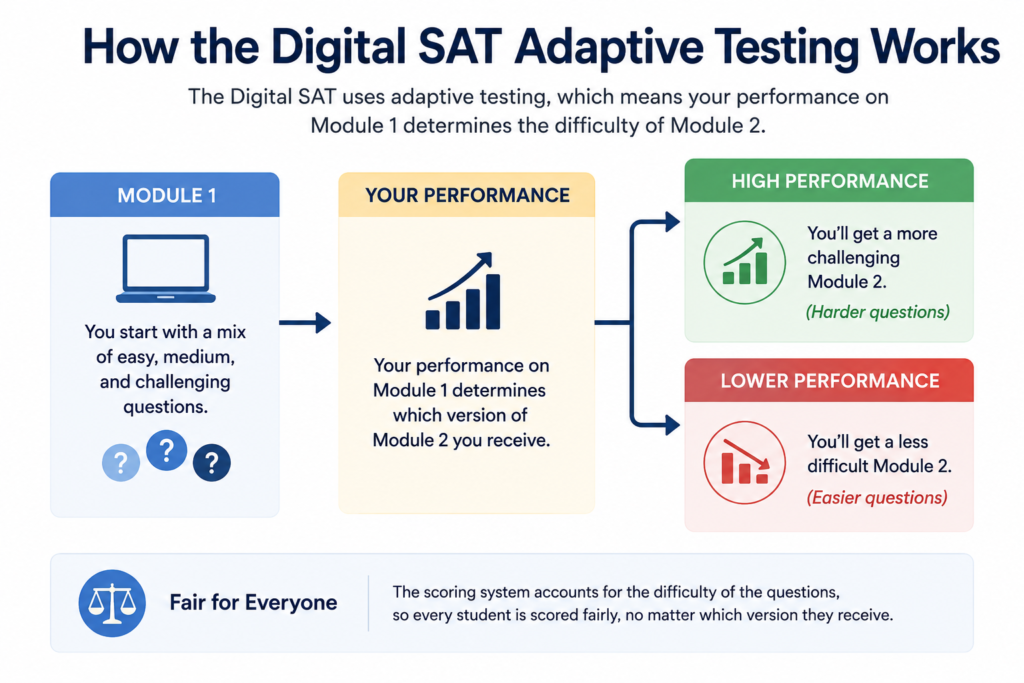
Unlike the previous paper-based SAT, the Digital SAT uses multistage adaptive testing.
This means that your performance on the first module influences the difficulty of the second module.
How the Digital SAT Is Scored: Understanding the SAT Score Range
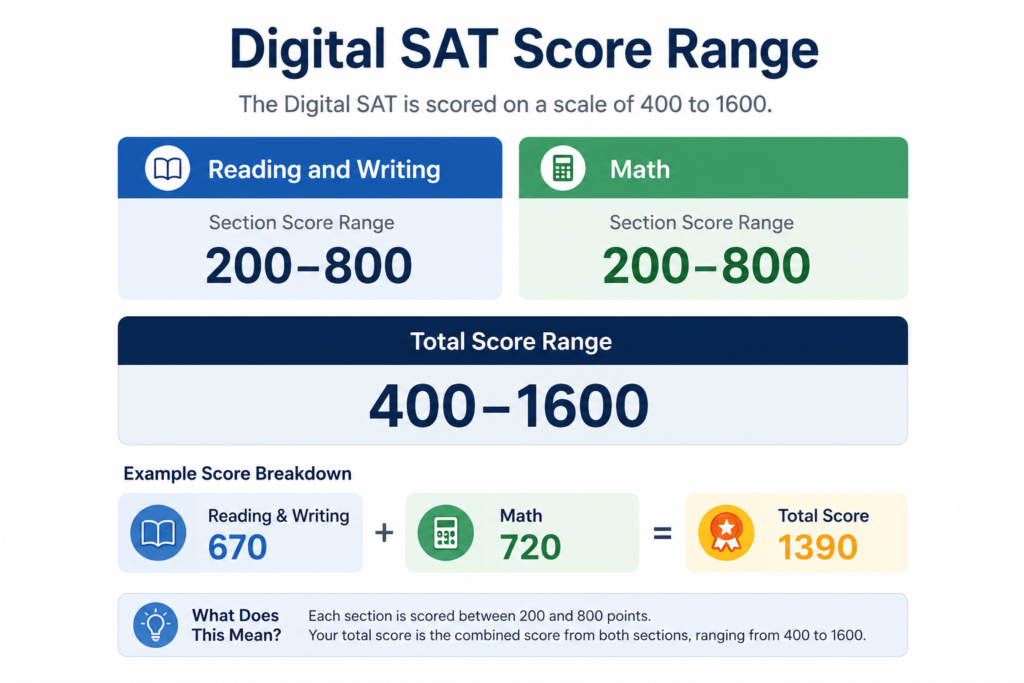
The total Digital SAT score ranges from:
400 to 1600
It is made up of:
| Section | Score Range |
|---|---|
| Reading and Writing | 200–800 |
| Math | 200–800 |
Total Score:
400–1600
For example:
Reading & Writing: 670
Math: 720
Total Score:
1390
How the Digital SAT Is Scored Through Adaptive Testing
One of the biggest differences between the paper SAT and the Digital SAT is adaptive testing.
Here’s how it works:
Module 1
Every student begins with a module containing a mix of easy, medium, and challenging questions.
After completing Module 1, your performance determines which version of Module 2 you’ll receive.
Students who perform well generally receive a more challenging second module, while students who struggle receive a less difficult version.
This doesn’t mean one student has an unfair advantage. The scoring system accounts for the difficulty of the questions when calculating scores.
Are Harder Questions Worth More Points?
Not directly.
Many students assume:
“Hard questions are worth more points.”
This isn’t exactly true.
Instead, the SAT scoring process considers:
- Which questions you answered correctly
- The overall difficulty of the module
- Statistical models used by the College Board
As a result, students who successfully answer more difficult questions often receive higher scaled scores, but there isn’t a fixed number of points assigned to individual questions.
Is There a Penalty for Wrong Answers?
No.
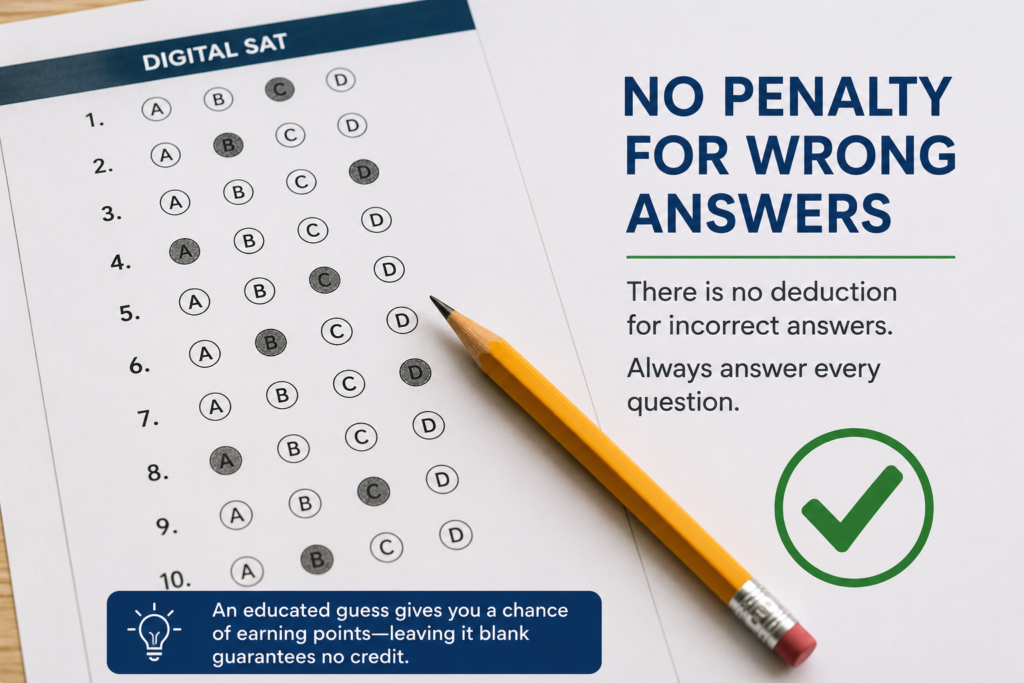
The Digital SAT does not deduct points for incorrect answers.
This means you should answer every question, even if you’re unsure.
An educated guess always gives you a chance of earning points, while leaving a question blank guarantees no credit.
How Many Questions Are on the Digital SAT?
The Digital SAT contains:
- 54 Reading and Writing questions
- 44 Math questions
Total:
98 questions
The test takes approximately 2 hours and 14 minutes, making it significantly shorter than the previous paper version.
How Is Your Final Score Calculated?
Your raw performance is converted into a scaled score.
While the College Board does not publish its exact scoring algorithm, the process generally includes:
- Counting correctly answered questions
- Considering the difficulty of the test module
- Converting results into scaled section scores
- Combining section scores into a total score out of 1600
This scaling process ensures fairness across different versions of the exam.
What Is a Good Digital SAT Score?
A “good” SAT score depends on your goals.
Here’s a general guideline:
| Score | Interpretation |
|---|---|
| 400–900 | Below average |
| 900–1100 | Average |
| 1100–1250 | Above average |
| 1250–1400 | Competitive |
| 1400–1500 | Excellent |
| 1500–1600 | Exceptional |
Keep in mind that different colleges have different expectations. Highly selective universities often admit students with scores well above the national average, while many excellent colleges take a more holistic approach and consider factors beyond standardized test scores.
Why Practice Test Scores Sometimes Change
Many students notice their score fluctuates between practice tests.
This is completely normal.
Possible reasons include:
- Different question difficulty
- Time management
- Test anxiety
- Fatigue
- Weaknesses in specific topics
- Careless mistakes
Instead of focusing on a single practice score, look for consistent improvement over several tests.
Common Myths About How the Digital SAT Is Scored
Myth 1: Every Question Is Worth the Same Number of Points
False.
The Digital SAT uses scaled scoring rather than assigning a fixed point value to each question.
Myth 2: Leaving Questions Blank Is Better Than Guessing
False.
There is no guessing penalty.
Always answer every question.
Myth 3: You Need a Perfect Test to Score Above 1500
Not necessarily.
Many students earn scores above 1500 while missing a small number of questions, depending on the difficulty of the test and how those responses are scaled.
Myth 4: Math Is More Important Than Reading
False.
Both sections contribute equally to your total score.
Math contributes up to 800 points.
Reading and Writing contributes up to 800 points.
How to Improve Your SAT Score
Understanding the scoring system is only the first step. Improving your score requires a focused study plan.
Here are a few strategies that consistently help students:
1. Take Full-Length Practice Tests
Simulate real testing conditions to build endurance and identify weak areas.
2. Review Every Mistake
Don’t just mark answers as right or wrong. Understand why you missed each question so you can avoid repeating the same mistake.
3. Strengthen Your Weakest Topics
Target areas where you lose the most points, whether that’s algebra, advanced math, grammar, or reading comprehension.
4. Practice Time Management
Knowing the material isn’t enough if you can’t finish the test. Learn to pace yourself so you have time to answer every question.
5. Develop a Consistent Study Schedule
Short, regular study sessions are generally more effective than cramming the week before the exam.
6. Consider Personalized Support
If you’ve plateaued despite self-study, working with an experienced tutor can help identify knowledge gaps, provide structured feedback, and keep you accountable.
Frequently Asked Questions
Is the Digital SAT easier than the old SAT?
The Digital SAT is shorter and uses adaptive testing, but it is designed to measure the same level of college readiness as previous versions. Most students find the experience more streamlined, though the overall difficulty remains comparable.
Can I use a calculator on the Digital SAT?
Yes.
A calculator is permitted throughout the entire Math section, and the testing platform includes the Desmos graphing calculator. You may also bring an approved handheld calculator if you prefer.
Do colleges know if I received an easier second module?
No.
Colleges only receive your final SAT score, not details about the modules you completed.
Can I improve my SAT score significantly?
Yes.
Many students improve through consistent practice, targeted review, and effective test-taking strategies. The amount of improvement varies depending on starting score, study habits, and available preparation time.
Final Thoughts
Understanding how the Digital SAT is scored gives you an advantage when planning your preparation. While the exact scoring formula is not publicly disclosed, knowing how adaptive testing, scaled scoring, and section weighting work can help you make smarter decisions during your study process.
Remember that your SAT score is just one part of your college application. Strong grades, meaningful extracurricular activities, compelling essays, and letters of recommendation all contribute to presenting a well-rounded application.
If you’re preparing for the Digital SAT and want personalized guidance, expert feedback, and a structured study plan tailored to your goals, STEM Prep Tutoring can help you build confidence and maximize your potential on test day.
Ready to Improve Your Digital SAT Score?
Whether you’re aiming to break 1200, reach the 1400s, or pursue a 1500+ score, having the right strategy can make a meaningful difference.
At STEM Prep Tutoring, we provide one-on-one SAT tutoring designed to help students strengthen their understanding, improve test-taking skills, and achieve their personal score goals.
Explore our SAT tutoring programs, read more expert SAT guides on our blog or contact us today to discuss a personalized study plan.