Does your child spend hours studying for a test, only to forget most of the material a few days later? The right study strategies for students can make a major difference in how well they understand, remember, and apply what they learn.
If so, the problem may not be a lack of effort. Many students rely on study habits that focus on re-reading notes, highlighting textbooks, or memorizing information the night before a test. These methods can create the feeling of learning without helping students retain information long-term.
The good news is that students can improve their memory and academic performance by changing how they study, not simply by studying longer.
Here are 10 effective study strategies parents can encourage their children to use.

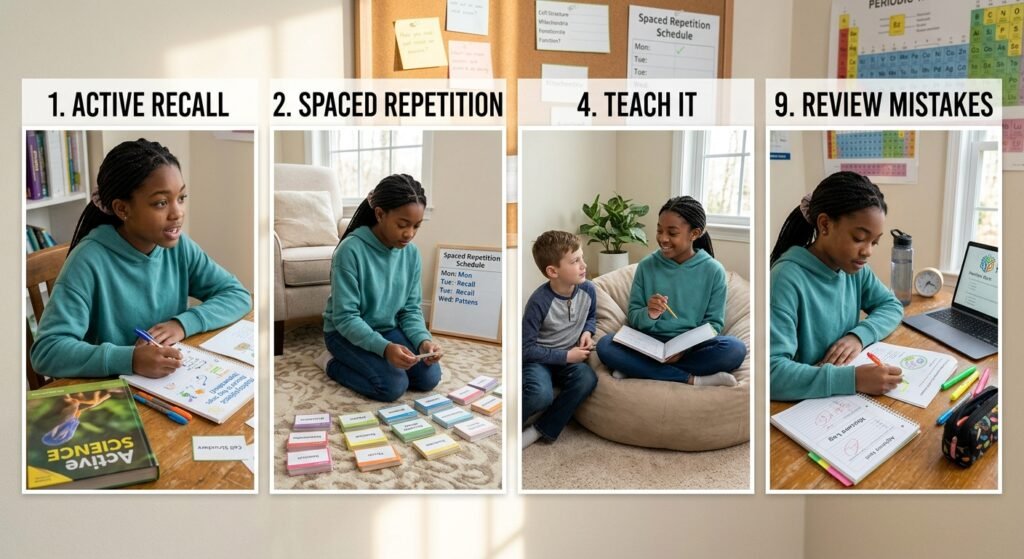
1. Use Active Recall as an Effective Study Strategy
One of the most effective ways to remember information is to actively retrieve it from memory.
Active recall is supported by research on learning and memory. The American Psychological Association highlights retrieval practice and spaced learning as effective approaches for improving long-term retention.
Instead of reading the same chapter several times, have your child close their book and ask themselves:
- What did I just learn?
- What are the three most important ideas?
- Can I explain this concept without looking at my notes?
- What questions could appear on the test?
This process, known as active recall, forces the brain to retrieve information rather than simply recognize it.
For example, after studying a biology lesson, your child could close their textbook and explain the process they just learned in their own words.
The goal isn’t to recognize the answer—it’s to recall it.
2. Use Spaced Study Sessions for Better Retention
Cramming may help students remember information temporarily, but it is rarely the best approach for long-term retention.
One of the most effective study strategies for students is to spread study sessions across several days instead of studying for three hours the night before an exam.
For example:
Monday: Learn the material
Tuesday: Review it
Thursday: Practice recalling it
Saturday: Complete practice questions
This is called spaced repetition, and it gives students multiple opportunities to retrieve information over time.
3. Turn Notes Into Questions
Simply copying notes isn’t always enough to help students understand and remember them.
Encourage your child to turn important information into questions.
For example:
Instead of writing:
Photosynthesis is the process plants use to convert light energy into chemical energy.
Write:
What is photosynthesis and how does it work?
Your child can then cover the answer and try to explain it from memory.
This turns passive notes into an active study tool.
4. Teach the Material to Someone Else
One of the simplest ways to test whether your child actually understands something is to ask them to teach it.
Have your child explain a concept to you, a sibling, or even an imaginary student.
If they can explain the topic clearly without constantly checking their notes, they probably understand it.
If they get stuck, that’s useful information too. It shows them exactly what they need to review.
This strategy can work particularly well for subjects such as math, science, history, and English.
5. Use Practice Questions to Strengthen Study Skills
Another effective study strategy for students is to practice using information instead of simply reviewing it.
For subjects such as math and science, encourage your child to solve practice problems after learning a concept.
For example, a student studying algebra shouldn’t only review formulas. They should practice applying those formulas to different types of problems.
Practice questions can reveal whether your child can actually apply what they learned, rather than simply recognize it.
6. Break Large Topics Into Smaller Sections
A large amount of information can quickly become overwhelming.
Instead of telling your child to “study biology,” break the material into smaller goals.
For example:
Monday: Cell structure
Tuesday: Cell functions
Wednesday: Photosynthesis
Thursday: Cellular respiration
Friday: Practice questions
Breaking studying into smaller sections can make difficult material feel more manageable and help students focus on one concept at a time.
7. Connect New Information to Something They Already Know
Students often remember new information more easily when they connect it to something familiar.
For example, when learning about percentages, a student might connect percentages to discounts while shopping.
When studying physics, they might connect a concept to something they experience in everyday life.
Ask your child:
“What does this remind you of?”
Creating these connections can make information easier to understand and retrieve later.
8. Use Different Ways to Practice the Same Concept
If your child studies something only one way, they may struggle when they encounter it in a different context.
Encourage them to approach important concepts from multiple angles.
They might:
- Read the concept
- Explain it aloud
- Draw a diagram
- Answer practice questions
- Create flashcards
- Solve a problem
- Teach it to someone else
For example, a student studying geometry could read the formula, draw the shape, explain the formula, and then solve several problems using it.
The more ways students interact with information, the more opportunities they have to understand it.
9. Review Mistakes Instead of Ignoring Them
Getting an answer wrong isn’t necessarily a bad thing. In fact, mistakes can show students exactly what they need to improve.
After completing homework, quizzes, or practice tests, encourage your child to review their incorrect answers.
Ask:
- What did I misunderstand?
- Where did I make the mistake?
- Did I misunderstand the question?
- Did I forget a formula or rule?
- What should I do differently next time?
Creating a mistake log can be especially useful.
Students can keep a running list of concepts and question types they frequently miss and review them regularly.
10. Create a Consistent Study Routine That Works
Good study habits are easier to maintain when studying becomes part of a routine.
Help your child establish:
- A consistent study time
- A quiet study location
- Clear daily goals
- Short breaks
- A system for organizing assignments
- Time for review before tests
A consistent routine can reduce procrastination and help students spend less time deciding when and what to study.
The goal isn’t necessarily to study for longer.
The goal is to study more effectively.
What If Your Child Is Studying but Still Forgetting Everything?
If your child is putting in genuine effort but continues to struggle with remembering information, it may be worth looking beyond the amount of time they spend studying.
They may need help with:
- Study techniques
- Time management
- Test-taking strategies
- Reading comprehension
- Note-taking
- Organization
- Understanding difficult concepts
- Building academic confidence
Sometimes the issue isn’t that a student isn’t working hard enough. They simply haven’t discovered the study strategies that work best for them.
How Tutoring Can Help
Personalized tutoring can give students more than additional homework. A tutor can help identify where a student is struggling, teach effective learning strategies, provide targeted practice, and adjust instruction around the student’s individual needs.
At STEM Prep Tutoring, personalized tutoring is designed around each student’s academic needs and goals. Students can receive support in areas such as Math, English/ELA, Science, and test preparation, while developing stronger study habits and greater confidence.
If your child is studying hard but struggling to retain what they learn, the solution may not be more studying. It may be learning how to study more effectively.
Ready to help your child become a more confident and effective learner? Explore STEM Prep Tutoring’s personalized academic support and discover how targeted instruction can help your child reach their academic goals.