
Does your child wait until the night before a test to start studying? The right test prep strategies can help students avoid last-minute cramming, retain more information, and walk into exams feeling more prepared and confident.
Last-minute studying can leave students stressed, tired, and unprepared. A better approach is to build consistent study habits that help students understand the material, remember it, and feel more confident on test day.
Whether your child is preparing for a weekly math quiz, a science exam, or a standardized test such as the PSAT or SAT, these test prep strategies can help them replace cramming with consistent preparation.
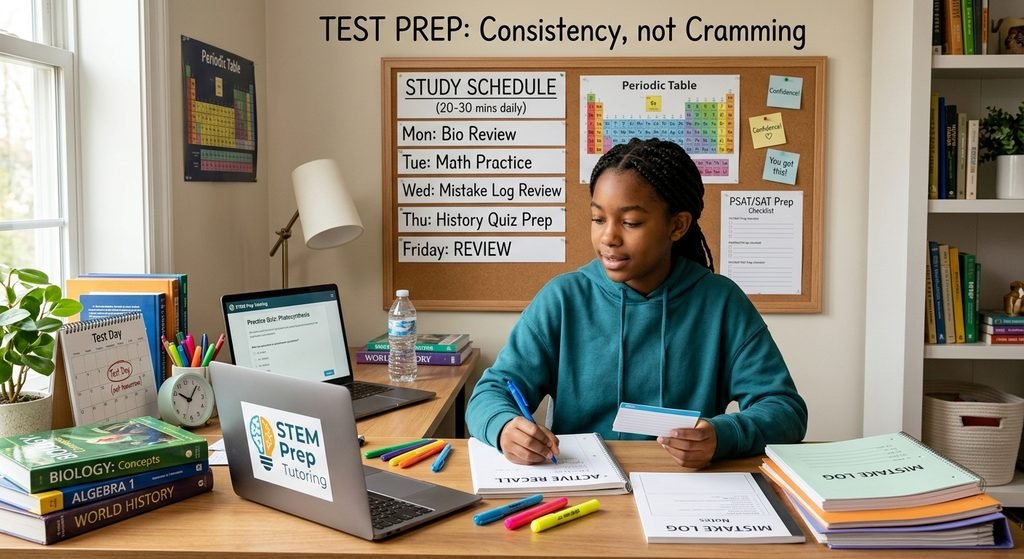
1. Use Test Prep Strategies to Create a Study Schedule
Instead of waiting until the night before, help your child break test preparation into smaller study sessions over several days.
A simple schedule might include 20–30 minutes of review each day leading up to the test. This makes studying more manageable and helps students avoid feeling overwhelmed by a large amount of material at once.
For example:
Monday: Review new material
Tuesday: Practice questions
Wednesday: Review difficult topics
Thursday: Complete a practice test
Friday: Review mistakes
A consistent schedule can also help your child develop better time-management skills.
2. Use Active Recall Instead of Re-Reading
Reading the same notes repeatedly can feel productive, but students also need to practice remembering information without looking at it.
After studying a topic, have your child close their notes and ask:
- What did I just learn?
- What are the main ideas?
- Can I explain this without looking?
- What questions might appear on the test?
This technique, known as active recall, encourages students to retrieve information from memory instead of simply recognizing it on the page.
The American Psychological Association also highlights retrieval practice and spaced learning as useful approaches to studying.
3. Use Practice Questions as Part of Your Test Prep
Students need more than an understanding of the material. They also need to know how to apply it.
Encourage your child to complete practice questions after reviewing a topic. For math and science, this could mean solving problems without looking at worked examples. For English, it might involve answering reading comprehension or writing questions.
Practice questions can reveal which areas your child understands and which ones still need attention.
They can also make test day feel less unfamiliar because students have already practiced applying what they know.
4. Practice Under Real Test Conditions
Students who perform well at home may struggle when a timer, classroom, or unfamiliar test format adds pressure.
Have your child occasionally practice under realistic conditions:
- Set a timer
- Put away notes and phones
- Complete questions in one sitting
- Avoid unnecessary interruptions
This can help students become more comfortable with the pace and pressure of an actual exam, including standardized tests such as the PSAT and SAT.
For students preparing for the SAT, consistent practice and targeted preparation can be more effective than trying to learn everything in the final few days.
5. Review Mistakes Instead of Ignoring Them
Getting a question wrong can be one of the most useful parts of studying—if your child takes time to understand the mistake.
After a quiz or practice test, ask:
What went wrong?
Was it a misunderstanding of the topic? A careless mistake? A missed instruction? Running out of time?
Encourage your child to keep a simple mistake log. Recording the types of questions they repeatedly miss can help them identify patterns and focus their study time where it matters most.
6. Break Difficult Subjects Into Smaller Goals
Telling your child to “study math” or “study science” can make the task feel too large.
Instead, break the material into specific goals.
For example:
Monday: Review equations
Tuesday: Practice word problems
Wednesday: Review difficult concepts
Thursday: Complete practice questions
Friday: Review mistakes
Breaking a large subject into smaller tasks makes studying feel more manageable and can help students stay focused.
7. Address Test Anxiety Before Test Day
Some students know the material but struggle to perform under pressure.
If your child regularly says, “I know it at home, but I forget everything during the test,” anxiety may be part of the problem.
Encourage simple habits such as taking slow breaths, reading directions carefully, starting with questions they understand, and avoiding rushing.
Parents can also remind students that one test does not define their academic ability.
Building confidence before test day is just as important as reviewing the material.
8. Get Extra Support When They Need It
Parents can provide encouragement, but they don’t always have the time or expertise to reteach difficult math, science, or English concepts before every test.
A math tutor, science tutor, or English tutor can provide targeted support when a student has knowledge gaps or struggles with test-taking skills.
Personalized tutoring can also help students develop better study habits, stay accountable, and prepare consistently rather than waiting until the night before an exam.
At STEM Prep Tutoring, students receive individualized academic support based on their strengths, challenges, and goals.
9. Protect the Night Before the Test
The night before an exam should not become another marathon study session.
Encourage your child to finish their review early, prepare what they need for the next day, and get enough sleep.
A tired student may have more difficulty concentrating, recalling information, and managing stress. Sometimes the best preparation is knowing when to close the books and rest.
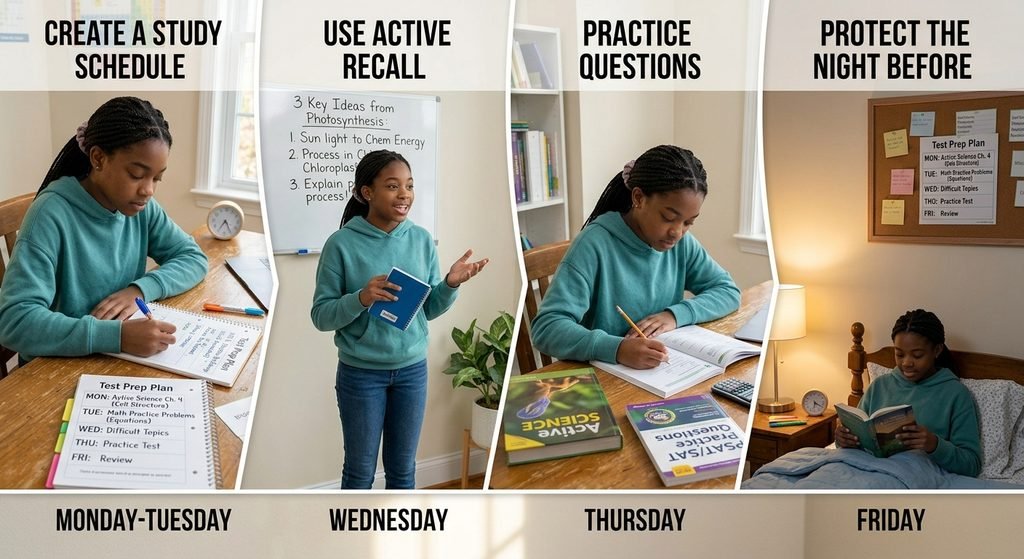
The Bottom Line
Effective test prep strategies are about consistency, not cramming.
When students spread out their studying, actively recall information, practice test-style questions, review their mistakes, and become familiar with test conditions, they can walk into exams feeling more prepared and confident.
If your child is struggling to prepare independently or continues to perform below their potential, personalized support can make a difference. STEM Prep Tutoring provides one-on-one Math, English/ELA, Science, and PSAT/SAT preparation designed around each student’s individual needs.
You can also help your child identify their strengths and areas for improvement with the Free SAT Diagnostic Test.
Help your child replace last-minute cramming with smarter study habits and a plan that works.