Does your child understand addition, subtraction, multiplication, and division but suddenly gets stuck when those same skills appear in a word problem?
You may see your child confidently solve a page of straightforward math problems, only to freeze when the question becomes a short story. They may struggle to figure out which operation to use, become frustrated, or simply guess.
If you’ve ever thought, “My child understands math but can’t solve word problems,” you’re not alone.
Math word problems require more than knowing how to calculate. Students must read carefully, understand what the question is asking, identify relevant information, choose a strategy, and apply the correct math skills.
Here are 7 common reasons your child may struggle with math word problems—and what can help.
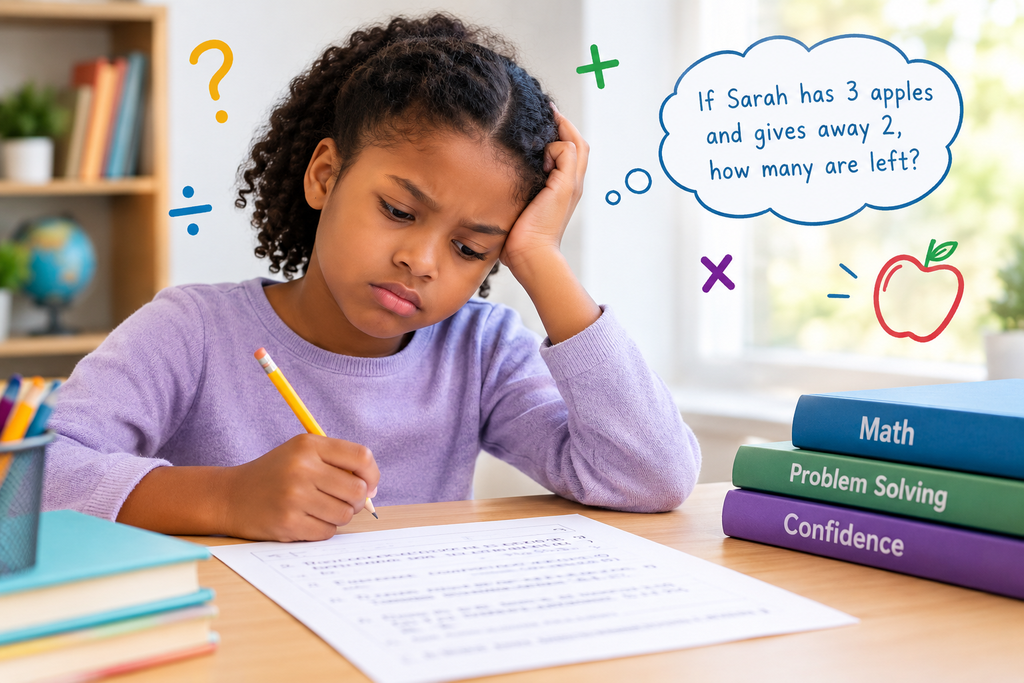
1. They Struggle to Turn Words Into Math
Some children understand mathematical concepts but have difficulty translating written language into a mathematical equation. Reading Rockets explains that solving word problems involves both reading comprehension and mathematical reasoning, which can make these problems challenging for some students.
For example, a child may know how to subtract 15 − 7 but struggle when asked:
“A class has 15 students. If 7 students leave early, how many students remain?”
The math itself isn’t necessarily the problem. The challenge is recognizing that the situation requires subtraction.
What helps: Practice identifying the mathematical action described in a problem before solving it. Encourage your child to explain the situation in their own words and then write the corresponding equation.
2. They Don’t Know What the Question Is Asking
Understanding mathematical vocabulary and the language used in a problem can play an important role in helping students understand what they’re being asked to solve.
They may see “12,” “5,” and “3” and immediately decide which numbers to add or multiply without asking what they are supposed to find.
What helps: Teach your child to read the question first and identify the goal. Ask:
“What do you need to find?”
Once they know what the problem is asking, they can determine which information matters and which strategy to use.
3. Multi-Step Problems Feel Overwhelming
A child may be perfectly capable of solving a one-step problem but struggle when a question requires several steps.
For example, they might need to:
- Calculate the total cost.
- Subtract a discount.
- Determine the remaining amount.
Trying to hold every step in their head at once can make the problem feel much harder than it actually is.
What helps: Break complex problems into smaller steps. Have your child solve one part, write down the result, and then use that answer to complete the next step.
4. They Don’t Have a Consistent Problem-Solving Strategy
If your child approaches every word problem differently, they may feel like they have to “figure it out” from scratch every time.
A consistent process can make word problems much less intimidating.
For example, your child could learn to:
- Read the entire problem.
- Identify what the question is asking.
- Highlight important information.
- Decide which operation or strategy is needed.
- Solve step by step.
- Check whether the answer makes sense.
What helps: Give your child a repeatable framework they can use on different types of word problems. The goal isn’t to memorize one trick; it’s to develop a reliable problem-solving process.
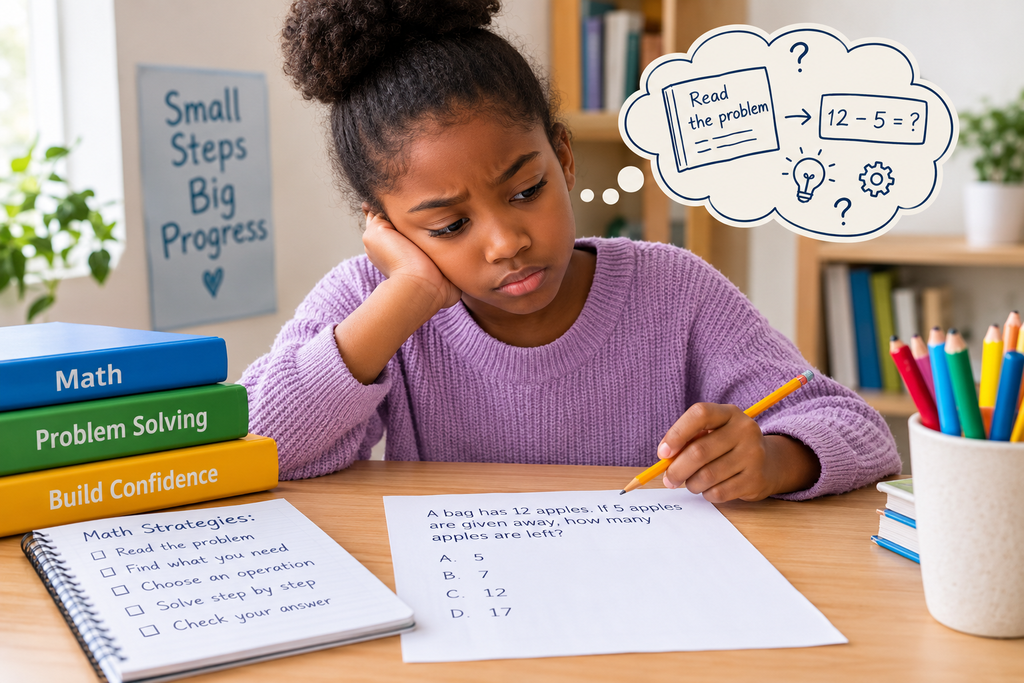
5. Math Anxiety Makes Them Freeze
Sometimes the biggest obstacle isn’t mathematical ability—it’s confidence.
A child who has struggled with word problems before may begin expecting to get them wrong. When they see a long paragraph instead of a simple equation, they may immediately think, “I can’t do this.”
That anxiety can make it harder to concentrate, understand the question, and work through the steps.
What helps: Keep practice manageable and focus on progress rather than perfection. Start with problems your child can solve successfully, then gradually introduce more challenging questions.
Most importantly, avoid labeling your child as “bad at math.” Encourage them to see difficult problems as skills they can learn with practice.
6. They Don’t Check Whether Their Answer Makes Sense
Getting the correct operation isn’t always enough.
A child can understand the problem and perform the calculation correctly but still make an error along the way. They may also give an answer that doesn’t make sense without realizing it.
For example, if a problem asks how many pencils remain after some are given away, an answer larger than the original number should prompt another look.
What helps: Teach your child to pause after solving and ask:
- Did I answer the question that was asked?
- Did I use the right information?
- Does my answer make sense?
- Is there another way I can check it?
This simple habit can help reduce avoidable mistakes.
7. They Haven’t Practiced Enough Word Problems
Being good at computation doesn’t automatically mean being good at mathematical reasoning.
If most of your child’s practice involves solving equations such as 24 ÷ 6 or 15 + 8, they may have limited experience applying those skills to real-world situations.
Word problems require a different kind of practice because students have to connect language, reasoning, and mathematics.
What helps: Give your child regular opportunities to practice different types of word problems. Free practice resources, such as Khan Academy’s word-problem exercises, can give students additional opportunities to apply their math skills in context.
The goal is to build familiarity so that word problems become something your child knows how to approach—not something they fear.
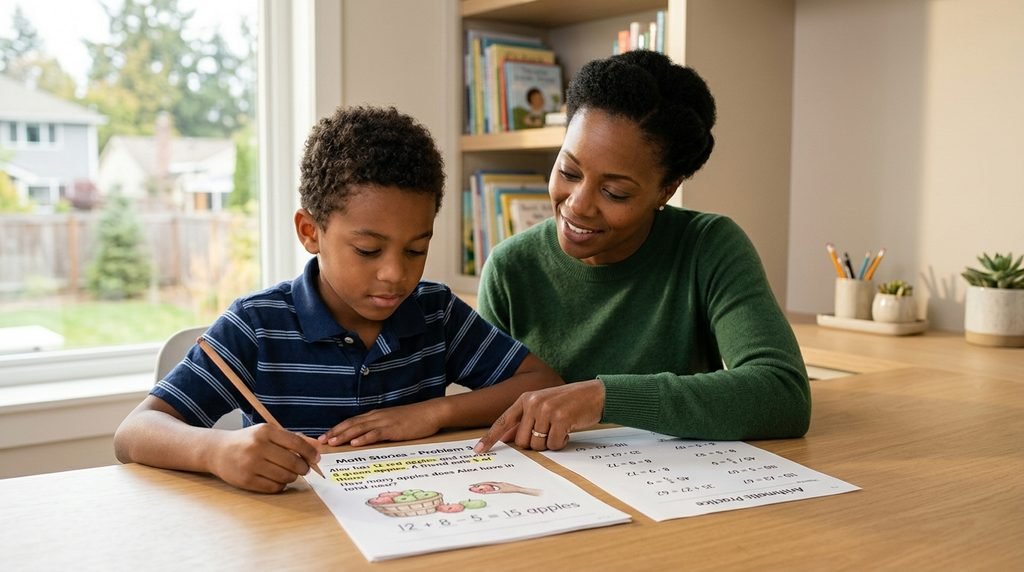
The Good News: Word Problems Are a Skill That Can Be Learned
If your child understands math but struggles with word problems, it doesn’t necessarily mean they lack mathematical ability.
Often, the missing piece is the ability to translate language into mathematics, organize information, choose a strategy, and explain their reasoning.
These are skills that can be developed with the right instruction and consistent practice.
A structured approach can help your child become more comfortable with word problems while strengthening their overall mathematical reasoning and confidence.
When Extra Math Support Can Help
If your child continues to struggle with word problems despite regular practice, personalized one-on-one math tutoring can provide targeted support.
At STEM Prep Tutoring, students receive individualized instruction designed around their specific strengths and challenges. Instead of simply giving students more problems to complete, tutoring can focus on understanding why they’re getting stuck and developing strategies they can use independently.
Whether your child needs help with basic math skills, mathematical reasoning, or solving more complex problems, personalized support can help them approach math with greater confidence.
Ready to help your child become a more confident problem solver?
Explore one-on-one math tutoring with STEM Prep Tutoring and learn how personalized instruction can support your child’s academic growth.