Does your child become frustrated when math homework comes out? Maybe they say, “I’m not good at math,” avoid difficult problems, or freeze when they see a challenging question.
Struggling with math can affect more than grades. When students repeatedly feel confused or unsuccessful, they may become less willing to participate, ask questions, or try challenging problems. The good news is that math confidence can be developed through the right support, practice, and learning strategies.
Here are 10 practical ways parents can help their child build confidence in math.

1. Make Mistakes Part of Learning
Some students become afraid of getting an answer wrong, so they stop taking risks and avoid difficult problems.
Help your child see mistakes as part of the learning process. The American Psychological Association recommends normalizing mistakes and focusing on the learning process rather than only the correct answer, particularly when supporting students experiencing anxiety.
Instead of focusing only on whether an answer is correct, ask:
“What did you try?”
“Where did you get stuck?”
“What could you try next?”
This shifts the focus from being right immediately to learning how to solve problems.
2. Strengthen the Math Basics First
A student who struggles with basic addition, subtraction, multiplication, fractions, or other foundational skills may find more advanced math frustrating.
Before moving on to increasingly difficult topics, identify the skills your child hasn’t mastered yet. Strengthening those foundations can make new concepts easier to understand and reduce the feeling of being constantly behind.
The U.S. Institute of Education Sciences recommends strengthening foundational math skills and using evidence-based instructional strategies to support students who struggle with mathematics.
A strong foundation gives students something to build on.
3. Break Difficult Problems Into Smaller Steps
A long or unfamiliar math problem can quickly overwhelm a student.
Teach your child to slow down and work through one step at a time. For word problems, they can:
- Read the question carefully
- Identify what information is given
- Determine what the problem is asking
- Choose a strategy
- Solve the problem
- Check the answer
Having a repeatable process can make difficult math feel more manageable.
4. Celebrate Progress, Not Just High Scores
Confidence grows when students can see evidence that they’re improving.
Instead of only celebrating a high test grade, recognize progress such as:
- Solving a problem independently
- Understanding a concept that was previously confusing
- Correcting a mistake without giving up
- Completing homework with less assistance
Small wins show your child that their effort is leading to progress.
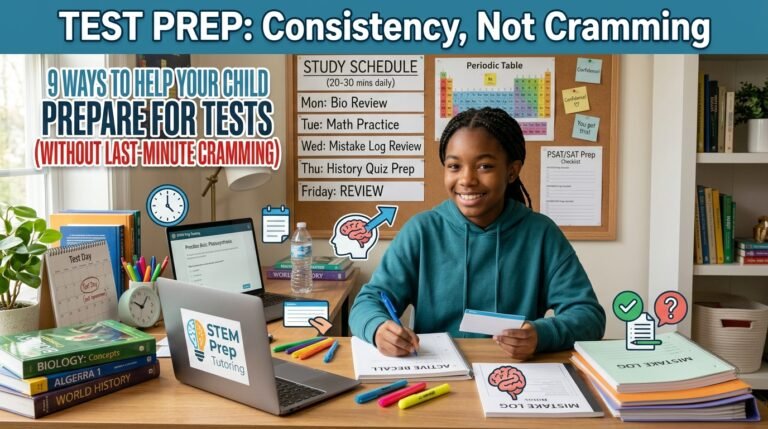
5. Practice Consistently Instead of Cramming
Trying to learn several math concepts the night before a test can increase frustration and stress.
Encourage shorter, consistent practice sessions throughout the week. A student might spend 20–30 minutes reviewing a concept, solving a few problems, and checking mistakes.
Regular practice gives students more opportunities to build familiarity and confidence before test day.

6. Connect Math to Everyday Life
Math can seem abstract when students don’t understand how it applies outside the classroom.
Look for simple opportunities to use math in everyday situations:
- Compare prices while shopping
- Calculate discounts
- Measure ingredients while cooking
- Create a budget
- Work out travel time or distances
Showing your child that math is useful beyond homework can make the subject feel more meaningful.
7. Replace “I’m Bad at Math” With More Helpful Language
Pay attention to how your child talks about their ability.
Statements such as:
“I’m just bad at math.”
can quickly become part of how a student sees themselves.
Encourage more specific language:
“I don’t understand this yet.”
or
“I need another strategy.”
The goal isn’t to pretend difficult math is easy. It’s to help your child understand that struggling with a concept doesn’t mean they are incapable of learning it.
8. Let Your Child Try Before Stepping In
When homework becomes difficult, it can be tempting to immediately provide the answer.
Instead, give your child an opportunity to try first. Ask guiding questions such as:
“What do you already know?”
“Which part makes sense?”
“What have you tried so far?”
This encourages students to think through problems independently and become less dependent on parents for every answer.
9. Practice Test-Taking Skills, Not Just Math Skills
Sometimes a student understands math but struggles to demonstrate that knowledge on a test.
Timed practice, reviewing common mistakes, reading questions carefully, and checking work can help students become more comfortable with math tests.
This is especially important for students preparing for standardized tests such as the PSAT or SAT, where knowing the math is only part of successful preparation.
10. Get Personalized Support When Your Child Needs It
Sometimes a student needs more than additional worksheets or reminders to practice.
A math tutor can identify specific learning gaps, explain difficult concepts in a different way, and provide targeted practice at the student’s pace.
Personalized tutoring can also give students a safe place to ask questions, make mistakes, and work through challenging problems without feeling embarrassed.
At STEM Prep Tutoring, tutoring is personalized around each student’s strengths, challenges, learning needs, and academic goals. The program uses baseline assessments to identify knowledge gaps and creates individualized plans for students across elementary, middle, and high school.

The Bottom Line
Learning how to build math confidence isn’t about making every problem easy. It’s about helping your child develop the skills, strategies, and persistence to work through problems without immediately assuming they can’t do it.
When students strengthen their foundations, practice consistently, learn from mistakes, and experience small wins, they can begin to see themselves as capable math learners.
If your child is struggling with math, avoiding difficult problems, or losing confidence in their abilities, STEM Prep Tutoring provides personalized one-on-one math support designed around how each student learns.
Help your child move from “I can’t do math” to “I can figure this out.”