Does your teen spend hours studying for the SAT but struggle to improve their practice test scores? Perhaps they understand the material in class but make careless mistakes, run out of time, or feel overwhelmed when taking a timed test.
These challenges are common among students preparing for college entrance exams. The problem isn’t always how much they study. Sometimes, it’s how they approach their preparation.
Effective SAT study strategies help students identify weak areas, practice the right skills, learn from mistakes, and build confidence before test day.
Whether your teen is preparing independently or working with a private tutor, these seven strategies can help them make better use of their study time and prepare more effectively for the SAT.
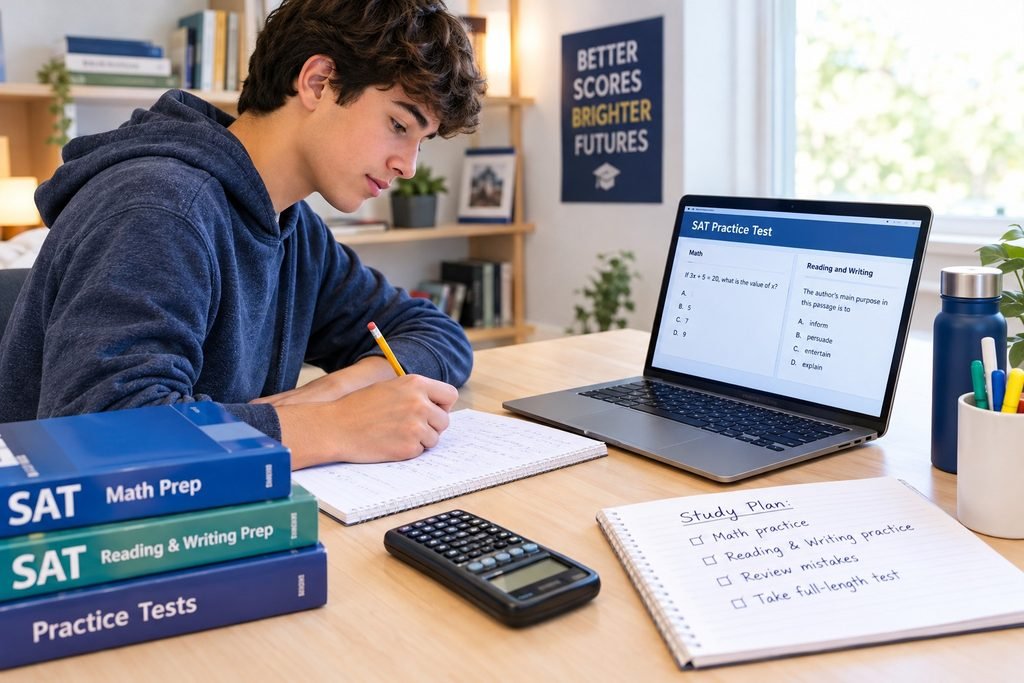
1. Start With a Full-Length SAT Practice Test
Before creating a study schedule, help your teen establish a baseline score by taking an official SAT practice test under timed conditions.
The College Board provides official SAT practice tests that students can use to familiarize themselves with the exam and identify areas for improvement.
The SAT is now digital, and the College Board provides official practice tests through its Bluebook application. Using these resources helps students become familiar with the exam’s format, question types, timing, and digital tools.
Why it works: A practice test reveals which skills need attention. Without this information, students may spend valuable study time reviewing topics they already understand while overlooking areas where they consistently lose points.
How parents can help:
After the test, encourage your teen to review their results and identify three common reasons for missed questions:
- Knowledge gaps: They didn’t understand the concept or rule being tested.
- Careless mistakes: They misread the question, selected the wrong answer, or made a calculation error.
- Time management problems: They spent too long on certain questions or rushed through others.
Each problem requires a different solution. Identifying the cause of a mistake is the first step toward correcting it.
Parent takeaway: Don’t focus only on the score. Use the results to build a study plan around your teen’s actual needs.
2. Set a Realistic Target Score and Create a Study Plan
Telling your teen to study harder may not help if they don’t know what they’re working toward.
Instead, help them establish a realistic SAT target based on their current performance, college preferences, and remaining preparation time.
Research the SAT score ranges published by your teen’s prospective colleges. Then compare those ranges with their baseline score to determine whether additional preparation could help them strengthen their application.
Why it works: A clear goal gives students direction and makes it easier to measure progress. Breaking preparation into smaller milestones can also help students who procrastinate or struggle with time management.
How parents can help:
- Record your teen’s baseline SAT score.
- Research the score ranges of their preferred colleges.
- Identify the Math and Reading and Writing skills that need improvement.
- Divide those skills into weekly study goals.
- Review progress using practice questions and periodic practice tests.
For example, a student who struggles with algebra might dedicate the first week to linear equations before progressing to systems of equations and more complex problems.
Avoid assuming that every student will improve by the same number of points in a fixed period. Progress depends on their starting level, skill gaps, practice quality, and consistency.
Parent takeaway: Focus on achievable weekly goals rather than putting pressure on your teen to reach a particular score immediately.
3. Study Consistently Instead of Cramming Before Test Day
Your teen might spend several hours studying on Saturday and then avoid SAT preparation for the rest of the week.
Although this approach may feel productive, irregular study sessions can make it harder to retain information and build consistent problem-solving habits.
A better approach is to spread practice across the week.
Why it works: Regular practice gives students repeated opportunities to retrieve information, strengthen understanding, and correct mistakes before they become habits.
How parents can help:
Encourage your teen to begin with manageable study sessions of approximately 30–45 minutes, four or five days a week, adjusting the schedule to fit their needs.
A weekly plan might look like this:
- Monday: Practice algebra and linear equations.
- Tuesday: Review Reading and Writing questions.
- Wednesday: Work on word problems and data analysis.
- Thursday: Practice grammar, punctuation, and sentence structure.
- Friday: Review missed questions and revisit difficult concepts.
The goal isn’t to follow this exact schedule. It’s to establish a routine your teen can maintain alongside schoolwork, extracurricular activities, and other responsibilities.
If your teen regularly postpones assignments or struggles to manage their workload, a predictable study schedule can also help them develop stronger time management habits.
Parent takeaway: Encourage consistency over marathon study sessions. A realistic routine is more useful than a demanding plan your teen cannot sustain.
4. Focus on Weak SAT Math Skills Before Doing More Practice Questions
Some students repeatedly complete SAT Math questions without addressing the concepts behind their mistakes.
For example, a student might answer several algebra questions incorrectly, review the correct answers, and then make the same errors on the next practice set.
The missing step is understanding why the answers were wrong.
Why it works: Targeted practice helps students strengthen specific skills instead of repeating problems without meaningful improvement.
The SAT Math section assesses skills across areas such as algebra, advanced math, problem-solving and data analysis, and geometry and trigonometry.
Students can review the College Board’s official SAT Math section guide to understand the content areas assessed and identify topics that need more practice.
How parents can help:
Start by identifying the topics where your teen struggles most. Then organize practice around those areas.
For example:
- Algebra: Practice linear equations, systems of equations, and inequalities.
- Advanced math: Review quadratic equations, functions, and equivalent expressions.
- Problem-solving and data analysis: Work on percentages, ratios, rates, statistics, and interpreting data.
- Geometry and trigonometry: Review relevant geometric relationships, area and volume, and right-triangle trigonometry.
Encourage your teen to explain how they arrived at an answer instead of memorizing a solution.
When a student repeatedly struggles with foundational concepts, working with a math tutor can provide additional explanations, guided practice, and feedback tailored to their needs.
Parent takeaway: Help your teen understand the mathematical concepts behind each question. Repeating practice tests without addressing skill gaps can lead to frustration rather than progress.

5. Strengthen Reading and Writing Skills With Active Practice
A student can read quickly and still misunderstand the main point of a passage. Similarly, they may recognize a grammar rule but struggle to apply it when answering SAT questions.
The SAT Reading and Writing section requires students to interpret information, analyze passages, understand vocabulary in context, and apply standard English conventions.
For more information about the skills assessed, students can consult the College Board’s SAT Reading and Writing section guide.
Why it works: Active reading encourages students to engage with the meaning of a passage rather than simply moving through the words. Targeted grammar practice also helps them recognize patterns and apply rules more accurately.
How parents can help:
Encourage your teen to incorporate the following activities into their study routine:
- Summarize short passages: After reading an article, explain its central idea in one sentence.
- Identify evidence: Practice finding the words or details that support an answer.
- Study vocabulary in context: Use surrounding sentences to work out the meaning of unfamiliar words.
- Review grammar rules: Practice punctuation, subject-verb agreement, sentence boundaries, and sentence structure.
- Explain answer choices: Ask why one answer is supported by the passage and why the alternatives are less appropriate.
Your teen can use articles on science, history, and other academic subjects to build reading habits. However, they should also practice official SAT-style questions because general reading alone does not fully prepare them for the exam’s specific question formats.
Students who consistently struggle with comprehension, grammar, or written expression may benefit from working with an English tutor.
Parent takeaway: Combine regular reading with targeted SAT Reading and Writing practice. Both are valuable, but they serve different purposes.
6. Keep an SAT Error Log to Learn From Mistakes
One of the most overlooked SAT study strategies is keeping a record of missed questions.
Many students complete practice sets, check their scores, and move on to the next assignment. Unfortunately, they may repeat the same mistakes because they haven’t identified the underlying problem.
An error log turns those mistakes into a structured learning opportunity.
Why it works: Reviewing errors helps students recognize recurring weaknesses, monitor progress, and focus their attention on skills that need further practice.
How parents can help:
Encourage your teen to create a notebook or spreadsheet with the following columns:
| Question or Topic | Reason for the Mistake | Correct Approach | Next Step |
|---|---|---|---|
| Linear equations | Forgot to distribute a negative sign | Distribute the sign before simplifying | Complete five similar questions |
| Reading comprehension | Chose an answer that sounded reasonable but lacked evidence | Eliminate choices unsupported by the passage | Practice evidence-based questions |
| Grammar | Misidentified a sentence boundary | Review independent clauses and punctuation | Complete a grammar practice set |
| Word problems | Rushed through the final calculation | Translate the information carefully and check the result | Practice multi-step problems |
Your teen should review the log at least once a week and attempt previously missed questions again without looking at the solutions.
If they can now solve a question independently and explain their reasoning, they are demonstrating a stronger understanding of the skill.
Parent takeaway: Encourage your teen to measure progress by the mistakes they learn to correct, not just the number of questions they complete.
7. Practice Under Realistic Test Conditions
Knowing the material is important, but students must also be able to apply their knowledge within the SAT’s time limits.
Some students perform well during untimed practice but struggle when they have to make decisions quickly. Others become anxious during longer tests and rush through questions they could otherwise answer correctly.
Why it works: Timed practice helps students become familiar with the exam’s pacing and develop strategies for managing their time.
How parents can help:
Have your teen take an official full-length digital SAT practice test periodically, using the Bluebook application and following the applicable testing instructions.
Between full-length tests, use shorter timed practice sets to work on specific skills.
Encourage your teen to:
- Read each question carefully before selecting an answer.
- Avoid spending too much time on one difficult question.
- Use the test’s available tools when appropriate.
- Check calculations and answer choices when time permits.
- Review mistakes after the session instead of focusing only on the score.
It’s also important to address test anxiety directly. If your teen freezes under pressure, help them develop a calm pre-test routine and practice approaching difficult questions one step at a time.
Remind them that they don’t need to answer every question immediately. Learning to manage uncertainty is part of effective test preparation.
Parent takeaway: Timed practice should help your teen become more comfortable with the exam, not become another source of pressure.

When Should Your Teen Consider SAT Tutoring?
Independent study can be effective, especially when students have a clear plan and can identify their weaknesses.
However, additional support may be useful if your teen:
- Studies regularly but sees little improvement in practice scores.
- Repeatedly makes the same Math or Reading and Writing mistakes.
- Struggles to identify which topics to study first.
- Has difficulty managing preparation alongside schoolwork.
- Understands concepts during lessons but struggles to apply them independently.
- Experiences significant anxiety during timed practice tests.
A private SAT tutor can help identify learning gaps, explain difficult concepts, review recurring mistakes, and organize preparation around the student’s needs.
Our one-on-one tutoring services help students strengthen their academic skills and prepare for important milestones, including the SAT.
Help Your Teen Prepare for the SAT With a Clear Plan
Improving SAT performance isn’t simply about spending more hours studying. It’s about using that time effectively.
By starting with a diagnostic test, setting realistic goals, studying consistently, strengthening weak skills, tracking mistakes, and practicing under timed conditions, your teen can approach preparation with greater direction and confidence.
If your teen needs help developing a personalized preparation plan, STEM Prep Tutoring can help.
Ready to take the next step? Visit STEM Prep Tutoring to explore our tutoring services and learn more about SAT preparation.
Help your teen build stronger skills, develop effective study habits, and work toward their college goals with a plan that fits their needs.